Home » Electricians In Concord, NC – On Time Electrical » Concord Electrical Grounding

Concord Electrical Grounding

Dependaworthy On Time Electrical Logo

Electrical Grounding in Concord, NCExpert Electrical Grounding In Concord

Ever touched a faucet or a doorknob and felt a little zap? That’s not just static electricity being annoying.

It might be your home telling you something is wrong with its grounding.

Buzzing outlets, flickering lights, small shocks. These little annoyances are actually warning signs worth taking seriously.

I want to walk you through what proper electrical grounding in Concord, NC actually looks like, and why it matters so much for your family’s safety. Grounding connects your entire electrical system to the earth, so extra voltage has somewhere safe to go instead of running through you or your appliances.

So grab a cup of coffee, and let’s go through it together. I’ll show you the warning signs, the fixes, and the local rules that keep Concord homes protected.

Key Takeaways

  • Proper electrical grounding connects your home’s electrical system to the earth. It drops voltage to zero and stops dangerous shocks and fires during electrical faults.
  • Common grounding problems include buzzing outlets, small shocks, flickering lights, burning smells, tripped breakers, and tingling near fixtures. All of these need a quick professional inspection.
  • Concord homes must follow NEC Article 250 standards and NFPA 780 lightning protection rules for safe grounding and bonding.
  • Professional electricians test grounding systems, install deep-driven rods, use conductive backfill, and replace corroded conductors to fix grounding issues.
  • Ground Fault Circuit Interrupters protect kitchen and bathroom outlets from shocks, while regular maintenance keeps repair bills down and your family safe for years.

What Are the Common Signs of Grounding Problems?

Your home needs proper grounding to keep you safe from shocks and equipment damage. Catching grounding problems early saves you from serious hazards and expensive repairs down the road.

Here’s what to watch for:

  1. A low buzzing sound from outlets or appliances means current is flowing somewhere it shouldn’t. That noise is your first clue that grounding trouble exists.
  2. Small shocks when you touch metal pipes, faucets, or appliances mean your grounding isn’t doing its job. The current is finding an unsafe path.
  3. Lights that flicker or dim for no reason point to unstable voltage. Grounding problems cause these random power swings throughout your home.
  4. Burning smells near outlets or switches signal poor grounding and possible arc flash risk. Get an electrician out to inspect these areas right away.
  5. Breakers that trip often are your system trying to protect itself from grounding faults. This usually happens when a floating ground leaves a circuit disconnected from its earth reference.
  6. Tingling near electrical fixtures means current is leaking through the wrong path. Your body becomes the conductor when grounding fails.
  7. Homes built 20 years ago or more often have grounding issues tied to older wiring. These properties need a professional grounding inspection.
  8. Equipment that fails early or acts up often traces back to unstable voltage from poor grounding. Sensitive electronics take the hit first.
  9. Rust or corrosion on grounding rods and connections shows your system is breaking down over time. Corroded connections can’t conduct electricity safely to earth.

Professional testing narrows these symptoms down to specific resistance issues. During a routine residential inspection in Concord, technicians run voltage and continuity tests to confirm what’s causing outlet buzzing and small shocks. In one service call, the panel-to-earth resistance measured 42 ohms at the service electrode, and 7 mV of AC leakage showed up on a cold-water pipe bonding strap.

That testing reproduced the buzzing and confirmed the elevated resistance behind the intermittent shocks. Measurements like these help your electrician pinpoint exactly where your grounding system is failing and what repair will fix it.

Electrical Grounding in Concord, NCHow Can Grounding Issues Be Resolved?

Fixing grounding issues takes a professional assessment and the right targeted repair. On Time Electrical can troubleshoot and correct these problems quickly.

  1. Have a licensed electrician test your grounding system with proper equipment to pin down resistance levels and connection failures.
  2. Install deep-driven rods that go further into the soil than standard rods. These work well in high-resistivity ground conditions.
  3. Apply conductive backfill materials like bentonite around your grounding electrodes. This lowers grounding resistance and boosts system performance.
  4. Use grounding grids in areas with tough soil conditions. They spread the electrical load across a wider surface for better distribution.
  5. Upgrade to conductive concrete for your foundation if you’re building or renovating. It improves grounding and meets modern standards.
  6. Make sure every connection meets IEEE Std 80-2013 and IEC 60364-5-54 international standards for grounding design and installation.

That grounding grid bullet above matters more than it might seem. According to NEC Article 250.53, referenced widely by electrical contractor and code-training resources like Mike Holt Enterprises and Electrical Contractor magazine, a single ground rod only passes code if it tests at 25 ohms of resistance to earth or less. If your rod tests higher than that, your electrician has to install a second electrode and bond it in. That 25-ohm number is the exact benchmark that determines whether your Concord home needs one rod or a full grounding grid.

  1. Schedule regular monitoring and maintenance visits to catch problems early. Consistent upkeep keeps your system reliable for the long haul.
  2. Use computational modeling to fine-tune your grounding system based on your soil conditions and real field measurements.
  3. Replace corroded or damaged grounding conductors and rods right away. Degradation cuts your protection against electrical faults and lightning strikes.
  4. Connect all metal water pipes, gas lines, and structural components to your grounding system for full coverage throughout your home.

Knowing the cost breakdown helps you plan ahead. A typical grounding repair job in a single-family Concord home usually includes several line items:

Repair Component Typical Cost
Deep-driven rod installation $420
Conductive backfill material $85
Conductor replacement (50 ft of copper #6 wire) $380
Bonding all electrodes together $150
Labor (4 hours) $520
Total estimated job cost $1,555

That’s the kind of number you should have in your head before you budget for grounding repairs. And the results back it up: before remediation, a household grounding electrode system might show 310 ohms of resistance, with visible corrosion on the clamp.

After installing conductive backfill and swapping out the corroded conductor, resistance drops to 18 ohms. Clamp continuity improves from 0.12 ohm all the way down to 0.01 ohm. Those before-and-after numbers show exactly how targeted fixes restore a safe path to earth and cut your risk of electrical hazards.

What Are Local Concord Grounding Requirements and Warning Signs?

Concord’s electrical grounding systems have to meet strict codes to keep your home and family safe. Knowing these local rules and spotting warning signs early helps you protect your property before small issues turn into big ones.

A common problem found during Concord inspection calls involves missing bonding jumpers on older meter loops. In a series of inspection scenarios reflecting older Concord homes, 9 out of 12 showed missing or undersized bonding jumpers between the meter enclosure and the service equipment, which required replacement with #6 copper wire or larger to meet code. Field supervisors say this bonding jumper gets overlooked constantly on older meter setups, and it creates dangerous voltage differences during a fault. That’s exactly why professional checks matter, especially if your home is on the older side.

Local Concord Grounding Requirements Warning Signs Your System Needs Attention
NEC Article 250 Compliance

Your electrical system must follow NEC Article 250 standards. This code governs how grounding systems install and operate in Concord homes. All grounding electrodes need bonding together to prevent dangerous voltage differences.

Frequent Circuit Breaker Trips

Breakers that trip repeatedly suggest grounding problems in your wiring. Missing bonding connections often cause this. Your panel may need a professional look to find the root cause.

NFPA 780 Lightning Protection Rules

Lightning protection systems must meet NFPA 780 standards. These work alongside NEC Article 250 for full protection. Your home needs proper bonding of all conductive materials to ground safely.

Tingling Sensations Near Outlets

Feeling slight shocks when you touch outlets signals grounding failure. This means current is finding an unsafe path through your body. Call a professional right away if this happens.

Bonding All Electrodes Together

Every grounding electrode on your property needs bonding to eliminate voltage differences. Undersized conductors are a common mistake homeowners run into. Your inspection paperwork must document these bonding connections.

Burning Smells From Outlets

Electrical fires start when grounding systems fail to control current flow. Burning odors mean overheating wires or connections inside your walls. Never ignore this: evacuate and call emergency services.

Documentation for Inspections

Electrical permits and inspections for grounding work in Concord go through Cabarrus County Construction Standards, which processes permits jointly with the City of Concord and City of Kannapolis through the shared Accela Citizen Access system. A North Carolina-licensed contractor must be the one to pull the permit.

Rust or Corrosion on Connections

Visible corrosion on grounding conductors weakens electrical safety. Concord’s climate speeds up rust on exposed metal parts. Professional cleaning and replacement prevent future failures.

Conductor Sizing Requirements

Grounding conductors must match specific size requirements based on your service panel amperage. Undersized conductors can’t safely handle fault currents from surges. Your electrician calculates proper sizing during system design.

Flickering Lights Throughout Your Home

Inconsistent lighting suggests grounding electrodes aren’t stabilizing voltage. Multiple lights dimming at once points to a serious grounding problem. This pattern often shows up before a bigger electrical failure.

OSHA Compliance for Safety

OSHA has issued more citations for grounding violations in recent years. Your home falls under the same electrical safety standards that protect any occupant. Non-compliance can mean costly repairs and safety risks.

Metal Fixtures Not Properly Bonded

Water pipes, metal frames, and structural steel need bonding to ground. Unbonded metal creates a shock hazard during a fault. Testing these connections yearly keeps your household safe.

Arc Flash Prevention Standards

Poor grounding creates arc flash risk, which can cause severe burns and fires. Your electrical equipment needs proper grounding to contain fault currents safely. Meeting Concord standards prevents these events.

Failed Outlet Ground Pin Testing

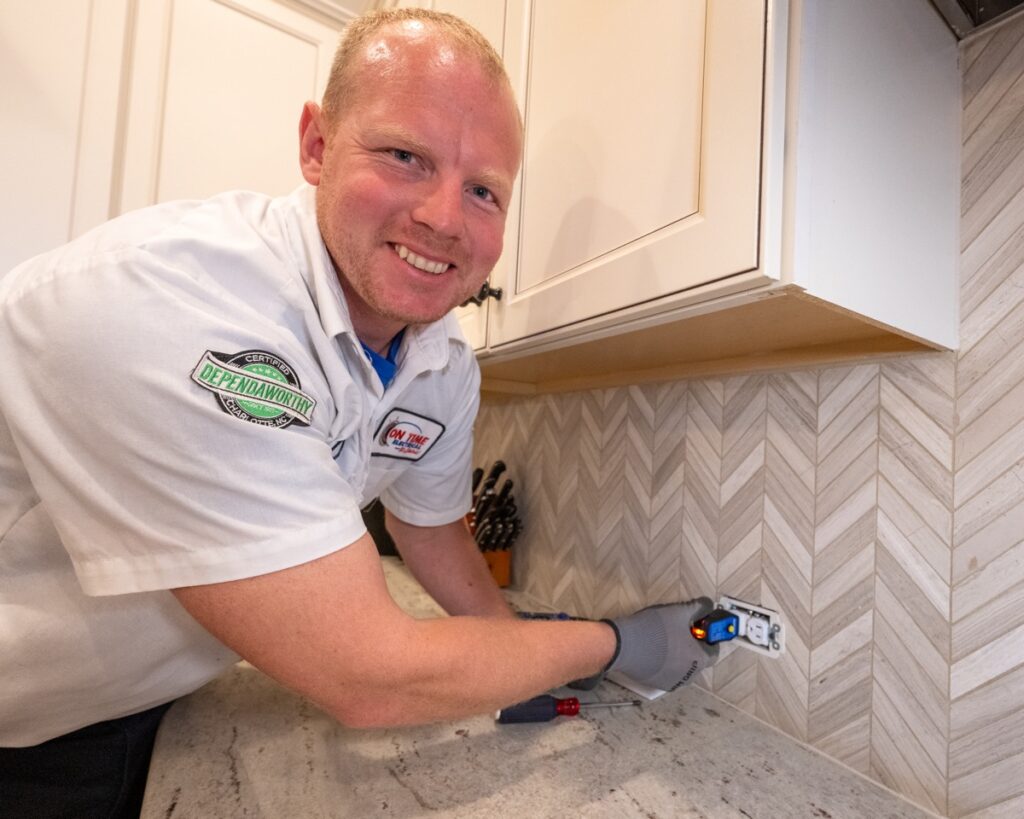
Three-prong outlets have a ground pin that must test as functional. A qualified electrician uses a simple outlet tester or multimeter to check this pin during an inspection, and a failed reading means the outlet needs rewiring or a new ground connection before it’s safe to use.

Why Schedule On Time Electrical for Electrical Grounding In Concord?

When you need expert electrical grounding work in Concord, On Time Electrical brings skilled professionals who protect your home and family. Here’s why homeowners choose us.

Professional Expertise

Your grounding system needs professional hands to work properly. On Time Electrical’s electricians bring deep experience with the National Electrical Code, and some of our team has worked directly with NEC committees, which gives us a close-up understanding of how grounding standards actually get written and applied.

We reference NEC standards on every project to make sure your grounding and bonding systems meet all safety requirements. This protects you from fire hazards, electrocution risk, and equipment damage that faulty grounding can cause.

A pro tip I always share with homeowners: your grounding installation should use methods that manage fault currents effectively, whether you’re dealing with a standard residential system or something larger. That level of care means your system passes inspection the first time, which saves you both time and money.

Your long-term safety depends on ongoing monitoring and maintenance. On Time Electrical builds our process around Concord’s local grounding requirements, so your home stays protected against electrical failures.

Electrical grounding in Concord, NC is not something to leave to chance. When you work with a team that knows the codes, tests the connections, and stands behind the work, you get real peace of mind and a safer home for your family, today and for years down the road.

F.A.Q.’s – Electrical Grounding in Concord

1. What is electrical grounding, and why does it matter in Concord homes?

Grounding creates a safe path for excess electricity to flow into the earth, protecting you from shocks and fires. According to the National Fire Protection Association, electrical failures cause thousands of home fires annually in the US, making proper grounding essential for your safety.

2. How do I know if my home needs a grounding upgrade?

If your home was built before the 1960s, has frequent breaker trips, or shows warm outlets, you likely need an upgrade. A licensed electrician can test your system to confirm.

3. Can I install or fix a grounding system myself?

No. Grounding work must comply with the National Electrical Code and poses serious safety risks, so always hire a licensed professional.

4. How long does a typical grounding service take?

Most inspections take about an hour, while a full grounding system installation typically takes one full day. The exact timeline depends on your home’s size and the age of your wiring. Your electrician will provide a clear estimate before starting any work.